Matching and Creating Historical Wood Siding Patterns

As a specialty building materials distributor, one of our areas of expertise is in assisting our customers in creating unique siding patterns out of Cedar or Douglas Fir, as well as matching historical wood siding patterns that are no longer commonly used.  Our staff is well trained and versed in helping customers throughout the United States in matching wood siding patterns to maintain a building’s historical architectural details.   From custom shiplap patterns to log cabin sidings, tongue and groove patterns to channel sidings, we work closely with our customers to ensure the old world charm and exact specifications needed are met.

Custom Western Red Cedar Siding Patterns

Just recently, we were contacted to help match this clear, vertical grain Western Red Cedar 10” drop siding (also referred to as Dutch Lap Siding) for a repair that needs to be done on a very old cabin.   Since drop siding is no longer commonly produced in a 10” profile in Western Red Cedar, we are working with the contractor to make just enough of the cedar siding to make the repair in the most cost-effective manner possible to maintain the look of the cabin.   In this case, since the siding is painted, it can be easier to create something that will look exactly the same as the existing siding when the new pieces are installed and coated.

Vintage 10" Clear, Vertical Grain Western Red Cedar drop siding

clear, vertical grain western red cedar dutch lap siding

Historical Clear, Vertical Grain Old Growth Western Red Cedar painted drop siding

Other projects we have had the pleasure of working with include providing this fully dimensional 5/4×12” clear, vertical grain Western Red Cedar planks for a historical restoration of a Frank Lloyd Wright home in Michigan.  The Clear Cedar planks are installed directly over mahogany strips, just exactly as Frank designed the look many years ago.

5/4x12" Clear Vertical Grain full Dimension for Frank Lloyd Wright Project in MI

Need help matching a siding pattern?  Our process begins by carefully examining a piece of the existing siding.  It is carefully measured, and a “line drawing” is created and submitted to our customer for review.

Custom Historical Wood Siding Patterns for Sale

Next, we discuss the options of what material will be used to create the wood siding.  As mentioned previously, if the siding is to be painted, we have more options of grade and how the material will be manufactured.  If the siding will be left natural or stained, it will be of utmost importance to match the species and grade of wood exactly to what is on the building.  We specialize in providing custom siding patterns in Western Red Cedar, Alaskan Yellow Cedar, Douglas Fir, and other exotic and domestic hard and softwoods.

Before your next project, be sure to visit us!

www.CedarCountryLumber.com

360.757.6343

950 B Fountain Street, Burlington, WA  98233

We ship nationwide!

**Pricing Update** Cedar Shingles and Shakes imported from Canada

Things are still being sorted out regarding the softwood agreement and imposed tariffs by the US on Canadian softwood imports.  The last softwood agreement between our two countries was signed in 2006, and as of date, a new agreement has not been put in place.

Initially, it appeared that coniferous shingles and shakes were not part of the expired agreement, and pricing has stayed somewhat stable.  However, just days ago, the U.S. Customs and Border Protection have determined that coniferous shingles and shakes were part of this agreement and are now subject to the increased tariffs.

Today we received notice that all of the Western Red Cedar and Alaskan Yellow Cedar Shingles and Shakes we import from Canada have increased in price 20 – 25%.  Due to this, we are unable to honor any previous quotes on Cedar Shingles or Shakes.

For current pricing, please contact our sales staff

We can be reached at 360.757.6343 or by emailing sales@cedarcountrylumber.com

Western Red Cedar Shingles subject to new duties and tariffs

Canada has submitted a request for a meeting with the World Trade Organization to assist in the dispute with the US and Canada lumber softwood exports.  However, due to the strong demand from the rise in new housing in the US and tight supply, Canadian softwood lumber producers don’t appear to be concerned too much, and prices are expected to be high on all Canadian grown coastal Cedar and other imported softwoods throughout 2018.

For more information, please see the latest developments by clicking HERE

www.CedarCountryLumber.com

950 B Fountain Street, Burlington WA  98233

Ninzan Studio Alaskan Yellow Cedar Gate

Prized for its workability and cool yellow tone, Alaskan Yellow Cedar (also known as Alaskan Cypress or Pacific Coast Cypress), has the same insect, rot and decay repelling tannins and oils as Western Red Cedar, but is heavier and denser, which gives it more strength.  This rare and remarkably beautiful softwood is only grown in the Pacific coast region of North America but is not a true “Cedar” species.

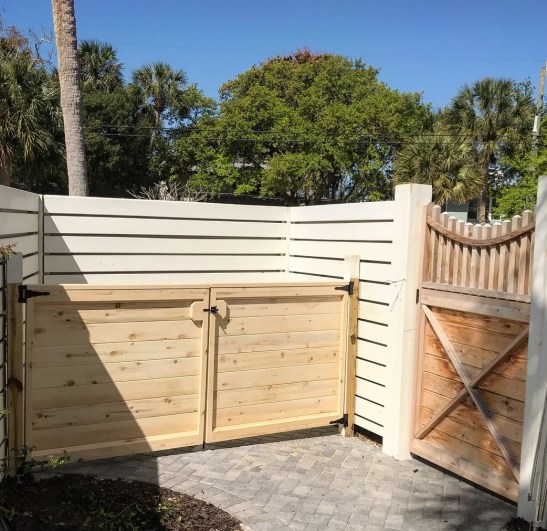
Located in Sarasota, Florida, our Instagram friends at Ninzan Studio were contracted recently to construct and install gates to match an existing fence made from Alaska Yellow Cedar.  When they were unable to find the products they needed in their local market, they contacted us to help them with their project.   We shipped them the materials they needed and combined with their superior craftsmanship; the new gates turned out beautifully!

Ninzan Studio makes a custom gate out of Alaskan Yellow Cedar, which is also called Pacific Coast Cypress

Clear, Alaskan Yellow Cedar is milled into pickets for a custom gate in Florida

Alaskan Yellow Cedar custom gates in Sarasota Florida

Clear, Alaskan Yellow Cedar custom cut gate pickets

Yellow Cedar Custom Gate

If you are on Instagram, be sure to give Ninzan Studio a follow!  And, before your next project, be sure to visit us!  We supply superior quality Western Red Cedar, Alaskan Yellow Cedar, and Douglas Fir building materials to homeowners and contractors nationwide at very competitive rates!

www.CedarCountryLumber.com

360.757.6343

950 B Fountain Street, Burlington, WA  98233

US and Canada Softwood Lumber Tariff Still in Dispute

After months of guessing when the US and Canada would come to an agreement on a the duties and tariffs associated with softwood lumber, it is believed that the final duty rates will range from 10 percent to 24 percent.  This is a bit lower than what our industry expected.  Most mills and importers were expecting as much as 30% increase.

Read more about the history of the Canada–United States softwood lumber dispute, which has been going on since the 80’s, HERE

“This tariff only adds to the burden by harming housing affordability and artificially boosting the price of lumber,” said NAHB Chairman Granger MacDonald. “It is nothing more than a thinly-disguised tax on American home buyers, home builders and consumers.”

Canada says they will appeal this decision.  Please read more HERE

Truck of Western Red Cedar

Because of this on going dispute, we do our very best to honor any price quotes to the best of our ability, however, all material is subject to prior sale and pricing is subject to change on all our softwood lumber.

http://www.CedarCountryLumber.com

950 B Fountain Street, Burlington, WA  98233

360.757.6343


UPDATE – 12/05

After the US announced its final decision on the Canadian softwood tariff in early November, our friends to the North aren’t very happy are launching litigation via the World Trade Organization over anti-dumping and countervailing duties.

Read more HERE


Finishing Western Red Cedar to Preserve its Natural Color

Left untreated, your Western Red Cedar (or Alaskan Yellow Cedar) will naturally weather to a silvery grey.  Especially in coastal areas where a “beachy” look is desired or by those concerned with applying finishes, this is a beautiful, natural choice.  Due to the unique inherent properties of Cedar, as long as proper installation and maintenance procedures are followed, it will perform satisfactorily for many years left untreated.

Should you desire to maintain the natural color of freshly milled Western Red Cedar (or Alaskan Yellow Cedar), a finish should be applied as soon as possible.  Ideally, this would be done before installation.  This helps protect the wood from moisture absorption and UV degradation, as well as job site dirt pick-up and mold and mildew.  Read more about this process HERE.

Used to preserve the Cedar’s natural color and appearance, transparent or semi-transparent solvent-borne penetrating stains are recommended.  Transparent stains are similar in composition to semi-transparent stains but contain fewer pigments that provide color. Generally speaking, the more pigment in the stain, the more ultraviolet light protection it provides.  When choosing a product, remember, “you get what you pay for”.  Quality stains will have fungicides included to inhibit the growth of mold and mildew to help protect your Cedar, as well as higher quality UV protectors.

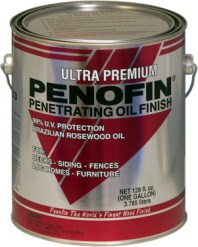
We currently offer in our store and recommend Ultra Premium Penofin Red Label Stains.

penofin-ultra-premium

Depending on whether you use a transparent or semi-transparent stain, they will require refinishing.  Service life will vary greatly depending on the product used, the amount of pigment and UV protectants, intensity of sunlight, moisture, and the surface texture the stain was applied to (stains last longer on textured surfaces than on smooth ones).

To date, some manufacturers have developed water-based stains with moderate success, however, they do not last as long or perform as well as the traditional solvent-borne stains.  As our marketplace continues to move toward using more environmentally friendly products due to consumer demand, we expect to see some amazing things coming our way soon!

Film-forming finishes such as lacquer, shellac, urethane and/or varnish are NOT recommended for use on Western Red Cedar (or Alaskan Yellow Cedar) for exterior use.  Regardless of the number of coats applied, the finish will eventually become brittle, crack and peel, leaving the wood exposed.  They are also challenging to remove.

For on-site application, penetrating stains may be applied by brush, sprayer, pad, or roller.  Since the stain is generally thin and watery, it is recommended to always back brush and do not allow the stain to pool on any surface.  During application, be sure to stir the stain to prevent the color pigments from settling.  The drier the Cedar, the more stain it can absorb.  Use caution when staining “green” or unseasoned wood as too not over apply stain.  Over application can cause a surface film that becomes sticky that dirt adheres to.

It is recommended that all four sides of each piece of Cedar are stained before installation.  A second field coat of stain is recommended, but only if the wood will accept a second coat.  For “green” or unseasoned wood, or that to be installed horizontally (such as decking), it is generally best to wait a few months to apply that second coat in place.

Cedar Sofit Stain Recommendation

Before your next project, be sure to visit us!

CedarCountryLumber.com

We ship nationwide!

360.757.6343

950 B Fountain Street, Burlington, WA

Howell Deck – Hat Island

We recently received these pictures of our customer’s project out on Hat Island.   They purchased the 2×6 Knotty Alaskan Yellow Cedar Decking from us last summer and recently completed the main floor deck.  As there is no ferry service to Hat Island, the customer arranged transportation with a local barge company to get him, his truck, and his decking over to the Island a little bit at a time.

Alaskan Yellow Cedar is an ideal choice for decking in the Pacific Northwest climate. Naturally resistant to rot and decay, West Coast Indian tribes used it for canoes and totem poles.  Alaskan Yellow Cedar is sought out for boat building, structural framing, siding, decking, and roofing in today’s marketplace.  Due to its ease of workability, it is also used for intricate carvings and in making musical instruments.

We hope you enjoy these beautiful pictures of the Howell’s lovely new deck and the view from their little piece of heaven out on Hat Island.

2x6 knotty alaskan yellow cedar decking installation

Knotty Yellow Cedar Decking for Sale

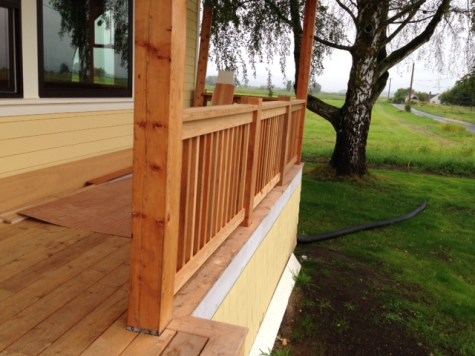
Alaska Yellow Cedar handrail

Alaskan Yellow Cedar Decking and Railing is ideal for damp climates

Weathered Alaskan Yellow Cedar Decking

This Alaskan Yellow Cedar was not treated and will be left to grey out, which is perfect for this beautiful island setting.  The integrity of the wood is not compromised in any way if left untreated.

In addition to Alaskan Yellow Cedar and Western Red Cedar decking, we also offer hardwood decking, such as our Red Balau “Mahogany,” as well as man-made composites including Azek, Timbertech, and Zometek.

Before your next project, be sure to visit us ~ we ship nationwide!

www.CedarCountryLumber.com

1.360.757.6343

950 B Fountain Street, Burlington WA

Why Are Cedar Prices Going Up?

You may have been surprised by the recent and/or impending price increases on Western Red Cedar lately.   This has been caused by a large trade dispute between Canada and the U.S. that has been going on since the 80’s on all softwoods imported from Canada.  Not only is this affecting Western Red Cedar, but it also affects Alaskan Yellow Cedar, Douglas Fir, Pine, and a host of other softwoods.

“Canada–United States softwood lumber dispute” Wikipedia

The Canada–U.S.A softwood lumber dispute is one of the largest and most enduring trade disputes between both nations.[1] This conflict was given rise in the early 1980s, and its effects are still seen today. British Columbia, the major Canadian exporter of softwood lumber to the United States, was most affected, reporting losses of 9,494 direct and indirect jobs between 2004 and 2009.[2]

The heart of the dispute is the claim that the Canadian lumber industry is unfairly subsidized by federal and provincial governments, as most timber in Canada is owned by the provincial governments. The prices charged to harvest the timber are set administratively, rather than through the competitive marketplace, the norm in the United States. In the United States, softwood lumber lots are privately owned, and the owners form an effective political lobby. The United States claims that the Canadian arrangement constitutes an unfair subsidy and is thus subject to U.S. trade remedy laws, where foreign trade benefiting from subsidies can be subject to a countervailing duty tariff to offset the subsidy and bring the price of the commodity back up to market rates.

The Canadian government and lumber industry dispute this assertion based on a number of factors, including that Canadian timber is provided to such a wide range of industries and that lack of specificity makes it ineligible to be considered a subsidy under U.S. law. Under U.S. trade remedy law, a countervailable subsidy must be specific to a particular industry. This requirement precludes the imposition of countervailing duties on government programs, such as roads, that are meant to benefit a broad array of interests. Since 1982, there have been four major iterations of the dispute.

For more information on why there has not been a resolution on this, and pricing is going up, we invite you to read this story from Global News published last Fall.

There is, unfortunately, little information regarding what is being done to come to an agreement on the importing of softwoods from Canada; the current deal has expired, and the marketplace is bracing for significant price increases.  Most companies implemented some price increases on February 1, 2017.

Because of this, we are doing our very best to honor any price quotes to the best of our ability. However, all material is subject to prior sale, and pricing is subject to change on a daily basis as this shakes out.

www.CedarCountryLumber.com

We Ship Nationwide!

360.757.6343

UPDATE – May 2, 2017

Here is a great article on who the 20% imposed tariff would affect the most and the approximate cost of a new home published by The Hill

UPDATE – August 1, 2017

Canadians are “Hopeful” for a softwood deal with the US this month.  Read more HERE

UPDATE – November 7, 2017

Canada to dispute decision on the softwood agreement with the US.  The U.S.          International Trade Commission will make a final rule on the issue by Dec. 18.  Read more HERE

Cedar Shingle Grades and Definitions

Old Growth Western Red Cedar being harvested to be made into Shingles

In North America, shingles and shakes are typically made from California redwood (Sequoia sempervirens), Western Red Cedar (Thuja plicata), and in some cases, Alaskan Yellow Cedar (Cupressus nootkatensis); while in Scandinavia and Central Europe, they are more commonly made from Pine (Pinus sylvestris).  Shingles are made from blocks that have been edge cut using a circular saw, whereas shakes are split. Shingles can be used on roofs, as well as sidewalls.

Shingles are manufactured by clamping blocks of wood into a carriage that slides back and forth across a blade, tilting and moving the block closer to the blade with each pass to automatically form a tapered cut that is thin on one end and thicker on the other. The thickness at the“butt” (the thicker end of the shingle) is generally about 3/8” but does vary. The final correct thickness for shingles is based using a stack of shingles rather than a single piece.

Western Red Cedar Shingles
At Cedar Country Lumber, we offer a wide selection of shingles made from Western Red Cedar, as well as Alaskan Yellow Cedar, that will help you achieve the look you desire in a wide range of price points; from custom-cut, dried, and colored shingles to utility-grade shingles that are much easier on the pocketbook, but perform admirably in any climate.

In today’s market place, Western Red and Alaskan Yellow Cedar Shingles are available in 3 common lengths

  • 16” ~ Also known as “Fivex”
  • 18” ~ Also known as “Perfection”
  • 24” ~ Also known as “Royals”

After the shingles are cut, they are graded into three main categories when using the Cedar Shake & Shingle Bureau’s Certi-label grading system.

  • Number 1 ~ Also known as “Blue Label”
  • Number 2 ~ Also known as “Red Label”
  • Number 3 ~ Also known as “Black Label”

Number 1 ~ the highest grade of shingles are 100% heartwood, 100% clear, and 100% edge grain. Western Red Cedar Shingles in this grade are sometimes referred to as “Blue Label”, which is a Registered Certi-label trademark. These are available in 16”, 18”, and 24” lengths in either Western Red Cedar or Alaskan Yellow Cedar. Our No. 1 Shingles are also available with a pressure-impregnated fire retardant or preservative treatment.

Number 2 ~ a perfectly acceptable grade for many applications. Some flat grain and limited sapwood are permitted. However, there is not less than 10” clear on 16” shingles, 11” on 18’ shingles, and 16” on 24” shingles. Western Red Cedar Shingles within this grade are sometimes referred to as “Red Label”.

Number 3 ~ a utility-grade for economy applications; commonly used on sheds and utilitarian buildings or for starter courses for higher grades. Within this grade, there is not less than 6” clear on 16” and 18” shingles, 10” clear on 24” shingles. This grade of Western Red Cedar Shingles are sometimes referred to as “Black Label” due to the grading system put into place by the Cedar Shake & Shingle Bureau.

Sidewall Cedar Shingles

Rebutted & Rejoined Cedar Shingles ~ Shingles that are sawn and re-manufactured on all four sides to ensure square butts and parallel edges for a superior appearance on sidewall applications. Rebutted and Rejoined Shingles are available in Number 1 and Number 2 grades and are available in all three lengths (16”, 18”, and 24”). These Shingles are commonly referred to as “R&R’s” and are predominately provided Kiln Dried and packaged in cartons rather than bundles.

#1 R&R Western Red Cedar Sidewall Shingles

craftsmanship by Ravenhill Construction

Pre-stained Western Red Cedar Shingles

If desired, Western Red Cedar R&R Shingles can be provided with a sanded or machine grooved face, as well as pre-primed or pre-stained in nearly every color and hue imaginable.  There are also 6 “off the shelf” colors of pre-stained shingles that you can choose from.

Pre-stained Western Red Cedar Shingles

craftsmanship by Impel Construction

Fancy Cut Western Red Cedar Shingles ~ manufactured from #1 Western Red Cedar shingles into a variety of shapes that are 3” & 5” widths cut from 18” & 24” lengths; offered in 8 different shapes, with an endless variety of custom cuts and finishes available. These shingles add unique charm and character to gable ends, balconies, fences, entryways, interior, and exterior walls. To find out more, please click HERE.

Western Red Cedar Fancy Cut Shingles

Because Western Red Cedar and Alaskan Yellow Cedar is only grown in the Pacific Northwest, where Cedar Country is located, we are YOUR premium source for Cedar Shingles and Shakes. We ship nationwide from one bundle or carton to full truckloads and extremely competitive pricing ~ even with freight.

Before your next project, be sure to visit us!

www.CedarCountryLumber.com

Toll-Free 866.757.6343

950 B Fountain Street, Burlington, WA

Alaskan Yellow Cedar Building Materials

Custom Milled Yellow Cedar T&G

In this photo – Custom Milled Alaskan Yellow Cedar T&G for a customer in New York

 A slow-growing tree found along the Pacific Coast from Oregon through Canada and up into Alaska, Alaskan Yellow Cedar trees can grow very tall, making it an ideal wood for large timbers used in timber frame construction.  It is also commonly referred to as Nootka Cypress.

Large Custom Cut Alaska Yellow Cedar Timbers

In this photo:  Custom Cut 8×8″ x 30′ long Alaskan Yellow Cedar Timber

We ship very large Alaskan Yellow Cedar Timbers anywhere in the US.

In this photo:  The 8×8″ x 30′ long Alaskan Yellow Cedar Timber is being loaded on to a flatbed truck for transport to our customer in upstate New York

Highly aromatic and slightly harder than Western Red Cedar, Alaskan Yellow Cedar is an excellent choice for most building applications where a lighter-hued wood is desired. Naturally resistant to rot and decay with good dimensional stability and workability, Alaskan Yellow Cedar is readily available in decking, custom and standard siding patterns, shingles, shakes, and dimensional lumber.

Custom Milled Yellow Cedar T&G

In this photo – Custom Milled Alaskan Yellow Cedar T&G for a customer in New York

We are pleased to share this photo collection with you where our Alaskan Yellow Cedar dimensional boards were used to make a stunning fence in the Seattle area. This beautiful fence will provide years of service and beauty to this customer’s property.

These awesome photos were shared with us, along with this quote
“We are so excited about the cedar. It is BEAUTIFUL” ~ Erika

Alaskan Yellow Cedar Boards Used for Fencing

Yellow Cedar Fencing

ayc-fence

Before your next project, be sure to visit us!  We ship nationwide!

http://www.CedarCountryLumber.com

950 B Fountain Street ~ Burlington, WA

Toll-Free 866.757.6343

Grades of Western Red Cedar

Throughout the wood industry, specific standards have been set so that there is consistency in grading when Western Red Cedar, as well as other lumber, is manufactured, as well as bought and sold. For the general consumer, this can be somewhat confusing.  Generally speaking, the higher the grade, the higher the price. So, when selecting and pricing lumber, it is vital to know the grade of material being purchased and how it is best used. Alaska Yellow Cedar is also graded similarly.

Clear, Western Red Cedar Timbers are used for an entry support

Here is an overview of the characteristics that determine the grades of Western Red Cedar:

Clear Western Red Cedar

  • Clear, Vertical Grain – This is the highest grade of Western Red Cedar and is commonly just referred to as “VG”. Vertical grain means that the growth rings are parallel to each other on the face of the board, and the wood is sawn specifically to achieve that look. Pieces have a smooth face of decay-resistant heartwood and are free from growth characteristics that affect appearance. Pieces have excellent dimensional stability and the ability to hold finishes very well. Generally used in siding and paneling products, but also found in trim and other dimensional boards; this product is generally supplied Kiln Dried and is ready to accept paint or stain either before installation or after.
Clear, Vertical Grain Western Red Cedar Siding

Clear, Vertical Grain Western Red Cedar Siding

  • Clear Heart – Includes only pieces with heartwood on the exposed face. Many of the pieces of Western Red Cedar are completely clear; others have minor imperfections that do not detract from their fine appearance. This product is also generally supplied Kiln Dried and would be ready to accept paint or stain.
  • A Clear – This is a fine appearance grade that allows only slightly more growth
    characteristics than Clear Heart. It is commonly referred to as A&Btr. Pieces are of mixed grain. These mixed grain (vertical and flat) pieces are graded from the surfaced face and typically sold with a percentage of B grade. A few small, sound tight knots or pin knots are allowed.
Clear, Mixed Grain Western Red Cedar

Clear, Mixed Grain Western Red Cedar

  • C&Btr Clear – High quality lumber for use where appearance is important, but permits more numerous characteristics than Clear Heart or “A” Grades. In addition to interior and exterior trim, as well as exterior cladding, Western Red Cedar of this grade is also used for cabinetry, doors, windows and similar applications. 4 knots per 12’ of each board is allowable.
  • No 2 & Better – The grade generally assigned for Western Red Cedar timbers and beams when the finest quality rough lumber is desired. The Cedar lumber is sound, well manufactured, and its characteristics do not detract from the wood’s fine appearance.

Clear No 2 Export Grade Western Red Cedar Timbers

  • D & Better Clear – This grade permits more natural characteristics and is used where general utility is more important than appearance. More pin knots and tight knots are allowed than within the other Clear Grades of Western Red Cedar. This grade is widely accepted in the construction of landscape structures and exposed timber framing, and is commonly used for arbors, pergolas, large trellises and porticos. Some pieces may require trimming to yield lengths for intended uses, and cutouts to remove less desirable portions can be common.
  • Rustic – Generally a grade of Clear Western Red Cedar Bevel Siding or cladding, it is recommended for use as sidewall covering where the distinctive charm of a rustic saw textured appearance is desired. This grade allows limited characteristics that do not detract from serviceability and may include pieces too thin to manufacture to standard sizes. Pieces may contain up to 4 sound, tight knots per 12’ of board and pin holes may be present.

Knotty Western Red Cedar

  • Select Knotty – Knots and other natural features define the visual characteristics of the Western Red Cedar. All knots are sound and tight. Red Cedar Lumber products are available rough surfaced, kiln-dried or unseasoned and smooth or with a re-sawn texture. Some companies may supply this grade of Western Red Cedar with knots glued on the reverse face and there is typically a percentage of Quality Knotty included in an order.
Knotty Western Red Cedar Siding

Select Knotty Western Red Cedar

  • Quality Knotty – Similar to Select Knotty, but a few small scattered holes are allowed, the grain may be heavily raised, and checks are not limited. Pieces must be serviceable, but 10% waste per board is allowed and is considered with the price of the material is set.  Because of this, a product in this grade is sold “as is” and returns or exchanges are generally not allowed.
  • Proprietary, Appearance or “Custom” Knotty – These products are graded to the manufacturer’s specifications to meet the intended end use. This is something that is commonly seen in the Cedar decking market as well as in large timbers for outdoor structures.  Boards often represent good value for appearances and uses with no holes. Allowances do vary based on manufacturer set standards and pricing is set accordingly. Less expensive materials would allow more waste, knots, and checking; while higher priced material would generally be of better quality. Depending on product, returns and exchanges may not be allowed.

Knotty Western Red Cedar Decking and Appearance Grade Cedar Timber

  • No. 2 and Better Structural – This grade is evaluated on structural characteristics, rather than appearance.
  •  Standard & Better Beams, Posts and Timbers – These items are intended for general construction use where serviceability is more important than appearance. No structural values are assigned. Most of the material will be box heart, meaning the timber is taken from the center of the Cedar tree and is less stable.  There may be oversized or missing knots, rot pockets, wane on edges and corners, and loose or course grain.  Items may be supplied surfaced (S4S) or with a re-sawn texture.

Please note, these grading standards do not apply to Western Red Cedar Fencing.  For information on grades of Fence materials, please click HERE

Western Red Cedar and Douglas Fir Lumber for Sales. We ship nationwide!

Before your next project, be sure to visit us!  Our team will be happy to discuss your individual project and make recommendations for the grade of Western Red Cedar to use, assist you with the correct amount of material to order, as well as provide you with installation tips.

We ship top quality Western Red Cedar lumber and building materials nationwide at competitive prices!

www.CedarCountryLumber.com

Ph 360.757.6343

950 B Fountain Street, Burlington WA  98233